Military Searching for Camp Lejeune Marines Due to Health Risk
(Bolivar, MO) -- Camp Lejeune in North Carolina is one of the largest Marine bases in the country.
That's usually a point of pride, but an internal investigation has the Marine Corps worried for all the people who visited the base over the years.
The Marine Corps tells KOLR10 News at least 500,000 could be at risk for health problems -- all because they drank the water.
Robert Stawarz says it was his duty to keep Camp Lejeune spotless during his two years there in the 1970s.
"Very, very clean. The U.S. Marine Corps, you know," he says. "Everything's immaculate."
The Vietnam-era veteran now lives in Bolivar, Missouri and thought his Marine days were over, until he checked the mail.
"I Received the letter from the IRS. I thought I was getting the letter from the IRS," he says.
Turns out the Marine Corps got his address from the IRS because he'd moved around so much.
"They had said that the IRS wasn't giving them any information about my taxes or anything like that and at first I thought it was kind of strange," Stawarz says.
The letter says that anyone who may have been on base at Camp Lejeune between 1957 and 1987 could be affected because of chemicals found in the drinking water.
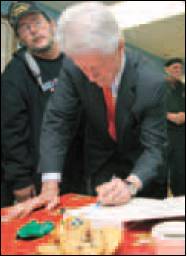
"When I got to the part about the bad water my jaw kind of hit the floor," Stawarz (right) says.
The Marine Corps tells him the chemicals originated from a building used to wash clothes.
"It was used in dry-cleaning and for de-greasing and somehow it got in the water," Stawarz says. "I guess they didn't really discover what was going on until the early 1980s."
The Marine Corps is now conducting a water study to pinpoint who exactly is at risk, and for what.
"I don't know what it does, if it causes cancer or it makes your fingers fall off," Stawarz says.
Stawarz was directed to a website to upload his contact information.
"I registered and they said they would let me know and in two months they would contact me," he says.
The Marine Corps tells KOLR10 more than 88,000 people have registered.
Stawarz says that's only a fraction of the veterans who could be affected, so he's getting the word out to his fellow marines.
"We're Marines until we die," he says.
The Marine Corps shut down the contaminated wells in 1985 and notified people who lived on base at that time.
But their records back to the 1950s are incomplete so we're told the Marines are working to build that registry to include former residents who have moved around or people who may have had friends on base and been exposed to the water.
If you or someone you know could be part of the group at risk, the Marine Corps is asking you register their information. You can call (877) 261 - 9782 or visit http://www.marines.mil.
////////////////////////////////////////////////////////////////////////////
I will believe the government is going to help these people when pigs learn to fly....
Thursday, October 30, 2008
Military Searching for Camp Lejeune Marines Due to Health Risk


500 Files Pulled From Shredder
500 Files Pulled From Shredder
By JOHN W. ALLMAN
jallman@tampatrib.com
Published: October 25, 2008
Updated: 10/25/2008 01:11 am
TAMPA - A review this week of 57 regional offices of the U.S. Department of Veterans Affairs has turned up nearly 500 benefit claim records that were set to be destroyed, agency officials said Friday.
The VA is now recommending that veterans - those who have not been contacted for six months or more about their claims for benefits - call their regional benefits office "to make sure the claim has been received, and everything is there," said Alison Aikele, the VA's press secretary in Washington, D.C.
The documents that were found in bins of paper waiting to be put through a paper shredder included veteran applications and change requests for benefits, which are needed to properly process an individual's claim.
The department is keeping in place an agency-wide ban on shredding while investigators from the VA's Office of Inspector General complete an audit of the St. Petersburg regional office. Staff there found eight documents in a shred bin last week that should not have been put there.
Investigators also have been asked to review allegations at two other regional offices that staff intentionally tried to destroy documents.
More than half of the 498 veterans' documents found in shred bins came from regional offices in St. Louis, Cleveland and Columbia, S.C. Both Columbia and St. Louis have placed one employee each on administrative leave pending the probe.
"There is a suspicion ... that those documents may have been mishandled intentionally," Aikele said.
As of Wednesday, only 18 benefits records had been found misplaced in shred bins at four offices. That number ballooned as each regional office stopped shredding and employees began going piece-by-piece through paper bins.
"We didn't really know what to expect," Aikele said.
The St. Petersburg regional office is the hub for all benefits claims for Florida's 1.8 million veterans. It had already been originally scheduled for a routine audit of mailroom operations prior to the Inspector General's discovery last week of misplaced documents in Detroit, St. Louis and Waco, Texas.
The question now facing the VA is how to determine how long such documents may have been placed in shred bins and how many documents might have been destroyed.
"We just don't know," Aikele said. "We don't have an idea how far back it could go."
Veterans can check the status of their benefit claims by contacting a VA call center at 1-800-827-1000.
Reporter John W. Allman can be reached at (813) 259-7915.
You just have to love the government
From: Fraud@gao.gov
To: TESTVET@aol.com
Sent: 10/30/2008 11:23:01 A.M. Eastern Daylight Time
Subj: GAO FraudNet Contract #52625
This responds to your October 10, 2008, Internet submission to the GAO FraudNet questioning why veterans/widows are not being properly cared for or compensated from the human/cold war experiments at Edgewood Arsenal.
We reviewed your information and found that the situation you describe is not within the scope of any on-going GAO work. Therefore, in accordance with GAO FraudNet policy to forward instances of wrongdoing to executive agencies for their review, we referred your concerns to the Department of Veterans Affairs, Office of the Inspector General (DVA/OIG), for their review and whatever action they deem appropriate.
GAO is responsible for assisting Congress in carrying out its oversight responsibilities pertaining to government programs, activities and functions. Generally, this involves examining the programs and operations of federal departments and agencies, rather than reviewing singular allegations of wrongdoing or poor performance in connection with specific matters.
If you have additional information, you may provide it directly to the (DVA/OIG), at their address: 810 Vermont Avenue, N.W.; Washington, D.C. 20420, Main Number (202) 565-8620, Hotline Number (800) 488-8244; or Fax # (202) 565-7936. Their e-mail address is: vaoighotline@mail.va.gov .
Thank you for your interest.
FraudNet
Government Accountability Office
441 G Street, N.W. mail stop 4T21
Washington, DC 20548
fraud@gao.gov
This is the letter I sent to them that solicited that response:
From: TESTVET
To: fraudnet@gao.gov
CC: aldy@suddenlink.net
Sent: 10/10/2008 12:56:01 P.M. Eastern Daylight Time
Subj: ref veterans who are being not properly cared for by DOD under NAS/IOM studies
the failure of the IOM MUFA Unit, DR William page to consider all relevant research data when conducting health studies for the IOM contracts to DOD that taxpayers are funding, yet veterans, widows and children are being denied necessary assistance from veterans benefits due to incomplete and shoddy reviews. Who can help us? This has also been sent to Congressman Filners Office, Chairman of the House VA Committee, Congressman John Hall, Veterans Oversight Committee, and the Secretary of the VA's office, his Assisstant Debi Bivens after more than 33 years since the experiments became public it's time to help these veterans and families. Please forward to someone in the GAO that can assist us please.
May 2004
CHEMICAL AND
BIOLOGICAL
DEFENSE
DOD Needs to
Continue to Collect
and Provide
Information on Tests
and on Potentially
Exposed Personnel
To Whom It May Concern, Who do I need to speak with concerning NAS/IOM reports that DOD and the VA use to justify either compensating or not compensating veterans or their widows. I am one of the enlisted men from the human experiments at Edgewood Arsenal in 1974. The Cold War Experiments ran from 1955 thru 1975.
I am also in contact with Jack Alderson, Commander, US Navy, Retired that is a member of the Operation SHAD/112 group and he has many of the same concerns as I have, that we are not getting a fair shake from the Department of Defense and less than complete health studies from the IOM MUFA unit, and DR William Page seems to be at the center of all of the MUFA studies that DOD used to decide compensation criteria for all of the veterans from the different programs, most were incomplete studies or some groups were never studied for long term health effects.
Bottom line, is the veterans have been ill served over the past 33 years since the final classified human experiments were stopped my President Ford in 1975, 33 years ago, many of the veteran are disabled or dead, at rates higher than normal for men our age. Which considering we were the healthiest young men the scientists had to choose from at the time, does not make sense, unless exposures, either deliberate or environmental exposure, or both could have played a part.
This recent manual from the NAS makes it plain that the veterans will never know the truth about the exposures http://www.nap.edu/catalog.php?record_id=11908
Authors:
Committee on Evaluation of the Presumptive Disability Decision-Making Process for Veterans, Jonathan M. Samet and Catherine C. Bodurow, Editors
Authoring Organizations
http://books.nap.edu/openbook.php?record_id=11908&page=298
LEVELS OF CLASSIFICATION
Policies governing DoD’s classification program are implemented through the Information Security Program (DoD, 1997). This regulation implements Executive Order 12958 (Clinton, 1995), “Classified National Security Information,” and has been codified at 32 CFR Part 159 (DoD Information Security Program. 2001. 32 C.F.R. § 159). “A security clearance is a determination that a person is eligible for access to classified information. ‘Need to know’ is a determination made by a possessor of classified information that a prospective recipient, in the interest of national security, has a requirement for access to, or knowledge, or possession of the classified information in order to accomplish lawful and authorized government purposes” (Pike, 2002). Current levels of classification are broadly contained under the headings of Unclassified, Limited, Confidential, Secret, Top Secret, Limited Dissemination (LIMDIS), Special Access Program (SAP), and Sensitive Compartmented Information (SCI) (Pike, 2002). Appendix L-2 provides a discussion of each of the categories of unclassified and classified information control.
No person may have access to classified information unless that person has been determined to be trustworthy and unless access is essential to the accomplishment of lawful and authorized government purposes, that is, the person has the appropriate security clearance and a need to know. Further, cleared personnel may not have access until they have been given an initial security briefing. Procedures are established by the head of each DoD component to prevent unnecessary access to classified information. (Pike, 2002)
There must be a demonstrable need for access to classified information before a request for a personnel security clearance can be initiated. The number of people cleared and granted access to classified information is maintained at the minimum number that is consistent with operational requirements and needs. No one has a right to have access to classified information solely by virtue of rank or position. The final responsibility for determining whether an individual’s official duties require possession of or access to any element or item of classified information, and whether the individual has been granted the appropriate security clearance by proper authority, rests upon the individual who has authorized possession, knowledge, or control of the information and not upon the prospective recipient. (Pike, 2002)
SECRECY AND MEDICAL RESEARCH
Numerous aspects of medical research have been classified on the basis of national security and have only recently been brought to public light. The
ACHRE Report (ACHRE, 1995) enumerated numerous radiation studies conducted during and after World War II which were classified, and some still have not been declassified. Although the Espionage Act of 1918 really began the era of national security classification, more and more documents have been classified with each new Presidential administration (ACHRE, 1995; Quist, 2002). Today the system is complicated and burdensome to use as discussed above. Medical research is still conducted and classified under the aegis of national security. This secrecy classification can establish hindrances in the medical care provided to the participants in these studies. All institutions that participate in medical research have some degree of classification for their projects, depending upon funding sponsor, subject, and agents used. Much of the current research on modern nerve agents, for example, is classified at the secret and above levels, even though there are many unclassified documents on nerve agents available to the public (IOM, 1993). And while DoD participates extensively in classified medical research studies, VA has not been excluded from such activities. Chapter 13 of the ACHRE Report outlined VA participation in maintenance of “confidential” files regarding radiation studies:
VA, similarly, was able to provide fragments of information that show that “confidential” files were kept in anticipation of potential radiation liability claims. However, neither the VA, nor the DOE and DoD (who evidently were parties to this secret record keeping), have been able to determine exactly what secret records were kept and what rules governed their collection and availability. (ACHRE, 1995, ch. 13)
(As explained in Chapter 10 of the ACHRE Report, VA concluded that a “confidential” division contemplated in relation to secret record keeping was not activated.)
VA publications did contain lists of several thousand (nonclassified) human experiments conducted at VA facilities; however, the information was quite fragmentary, and further information could not be readily retrieved (if it still exists) on the vast majority of these experiments. Thus, in looking for answers to questions about the secrecy of data on human experiments and intentional releases, we find record-keeping practices that leave questions about both what secrets were kept and what rules governed the keeping of secrets. (ACHRE, 1995, ch. 13)
Medical research involving human subjects must follow certain ethical and standard practice guidelines such as those established by the Nuremberg Code of 1947 (Trials of War Criminals Before the Nuremberg Military Tribunals, 1949). The 10 key elements of the Nuremberg Code are outlined in Appendix L-3.
Some medical research studies conducted prior to the Nuremburg Code implementation might not have followed the precepts of the code. Congressional inquiries during 1975 and 1976 requested that the Army Inspector General review the use of human volunteers in chemical agent research (IOM, 1993). An excerpted summary of this review (Taylor and Johnson, 1975) is presented in Appendix L-4. While this report concentrated on psychochemical testing conducted during the period 1950-1975, it also addressed the history of chemical warfare testing using human volunteers and the degree of compliance with the Nuremberg Code (IOM, 1993). The overriding conclusion from this report was that the secrecy applied to research using human volunteers “left ample room for misinterpretation, lack of knowledge about [guidelines governing human volunteers] and outright disregard for established policies and guidelines” (Taylor and Johnson, 1975, as referenced in IOM, 1993, p. 379). Concern regarding these conclusions remains today.
The issue of secrecy hindering medical treatment for veterans is amply exhibited in the IOM report Veterans at Risk: The Health Effects of Mustard Gas and Lewisite (IOM, 1993). Serious concerns were enumerated in the report over the secrecy issue demonstrated by DoD
This shows to some extent that the veterans have never been given any type of full access to data regarding the full extent of the experiments, all of the substances, how much of each substance were we exposed to, at what level does damage begin, did the scientists even know?
What effect did the toxins in the drinking water, surface water and soil of the training areas have on the men assigned to Edgewood Arsenal for the experiments, how much of the water was safe to drink, how much of the water did each veteran have to consume before long term health effects were started?
http://cfpub1.epa.gov/supercpad/cursites/ccontinfo.cfm?id=0300421 EPA Superfund site data for EA
ABERDEEN PROVING GROUND (EDGEWOOD AREA)
Contaminants
Site Profile | Aliases | Operable Units | Contacts
Actions | Contaminants | Site-Specific Documents
The below list only includes contaminants identified as contaminants of concern (COCs) for this site. COCs are the site-specific chemical substances that the health assessor selects for further evaluation of potential health effects. Identifying contaminants of concern is a process that requires the assessor to examine contaminant concentrations at the site, the quality of environmental sampling data and the potential for human exposure.
Media Contaminant Contaminant Group
Groundwater 1,1,1,2-TETRACHLOROETHANE VOC
Soil 1,1,2,2-TETRABROMOETHANE VOC
Groundwater 1,1,2,2-TETRACHLOROETHANE VOC
Groundwater 1,1,2-TRICHLOROETHANE VOC
Groundwater 1,1-DICHLOROETHENE VOC
Groundwater, Surface Water 1,1-DICHLOROETHYLENE VOC
Groundwater 1,2,4-TRICHLOROBENZENE Base Neutral Acids
Groundwater 1,2-DICHLOROBENZENE VOC
Groundwater, Surface Water 1,2-DICHLOROETHANE VOC
Groundwater 1,2-DICHLOROETHENE VOC
Groundwater, Surface Water 1,2-TRANS-DICHLOROETHYLENE VOC
Groundwater 1,4-DICHLOROBENZENE Base Neutral Acids
Soil 2-HEXANONE VOC
Sediment 2-METHYLNAPHTHALENE PAH
Sediment 4,4-DDE Pesticides
Sediment, Soil 4,4-DDT Pesticides
Groundwater ACETONE VOC
Groundwater ALUMINUM (FUME OR DUST) Metals
Groundwater, Sediment, Soil, Surface Water ANTIMONY Metals
Soil AROCLOR 1248 PCBs
Soil AROCLOR 1254 PCBs
Soil AROCLOR 1260 PCBs
Groundwater, Sediment, Soil, Surface Water ARSENIC Metals
Groundwater, Soil BARIUM Metals
Groundwater BENZENE VOC
Soil BENZO(B)FLUORANTHENE PAH
Groundwater BENZOIC ACID Base Neutral Acids
Soil BENZO[A]ANTHRACENE PAH
Sediment, Soil BENZO[A]PYRENE PAH
Groundwater, Sediment, Soil BERYLLIUM Metals
Groundwater BORON OXIDE Inorganics
Groundwater, Soil, Surface Water CADMIUM Metals
Groundwater CALCIUM Metals
Soil CALCIUM CARBONATE Inorganics
Groundwater CARBON DISULFIDE VOC
Groundwater CARBON TETRACHLORIDE VOC
Sediment CHLORDANE Pesticides
Groundwater CHLOROBENZENE VOC
Groundwater CHLOROFORM VOC
Groundwater, Soil CHROMIUM Metals
Groundwater CIS-1,2-DICHLOROETHENE VOC
Groundwater COBALT AND COMPOUNDS Inorganics
Groundwater, Sediment, Soil, Surface Water COPPER Metals
Groundwater CYANIDE Inorganics
Soil DIBENZO(A,H)ANTHRACENE PAH
Groundwater ETHYLBENZENE VOC
Soil HEPTACHLOR Pesticides
Soil HEPTACHLOR EPOXIDE Pesticides
Soil HEXACHLOROBENZENE Base Neutral Acids
Groundwater HEXACHLOROBUTADIENE Base Neutral Acids
Groundwater, Soil HEXACHLOROETHANE VOC
Soil INDENO(1,2,3-CD)PYRENE PAH
Solid Waste INORGANICS Inorganics
Groundwater, Sediment, Soil, Surface Water IRON Metals
Groundwater, Sediment, Soil, Surface Water LEAD Metals
Soil LEWISITE Base Neutral Acids
Groundwater, Sediment MAGNESIUM Metals
Groundwater, Soil, Surface Water MANGANESE Metals
Groundwater, Soil MERCURY Metals
Groundwater, Surface Water METHYLENE CHLORIDE VOC
Soil MUSTARD GAS Organics
Groundwater NICKEL Metals
Groundwater NITRATE Inorganics
Solid Waste NOT PROVIDED Not Provided
Soil OIL & GREASE Oil & Grease
Soil, Solid Waste PCBs PCBs
Sediment PHENANTHRENE PAH
Soil PHOSGENE Pesticides
Soil PHOSPHORUS (YELLOW OR WHITE) Inorganics
Groundwater POTASSIUM Metals
Groundwater, Surface Water SELENIUM Metals
Groundwater, Soil SILVER Metals
Groundwater SODIUM Metals
Groundwater TETRACHLOROETHENE VOC
Groundwater TETRACHLOROETHYLENE VOC
Groundwater, Soil THALLIUM Metals
Groundwater TOLUENE VOC
Groundwater TRANS-1,2-DICHLOROETHENE VOC
Groundwater TRICHLOROETHENE VOC
Groundwater, Surface Water TRICHLOROETHYLENE VOC
Groundwater VANADIUM (FUME OR DUST) Metals
Groundwater, Surface Water VINYL CHLORIDE VOC
Solid Waste VOC VOC
Groundwater XYLENES VOC
Groundwater, Soil, Surface Water ZINC Metals
Return to Search Results Return to Search Superfund Site Information
DISCLAIMER: Be advised that the data contained in these profiles are intended solely for informational purposes use by employees of the U.S. Environmental Protection Agency for management of the Superfund program. They are not intended for use in calculating Cost Recovery Statutes of Limitations and cannot be relied upon to create any rights, substantive or procedural, enforceable by any party in litigation with the United States. EPA reserves the right to change these data at any time without public notice.
OSWER Home | Superfund Home
These toxins cause medical problems in every body system there is. Yet the VA refuses to acknowledge we may have been harmed by the exposures, why?
http://www.ehponline.org/members/1994/102-1/munro-full.html Jan 1, 1994 National Institute of Health Report on damage caused by exposure to Sarin and GB this report shows cardiovascular problems related to low level exposures of Sarin yet DR Page ignored it when he wrote his March 2003 IOM Sarin Report based on the Edgewood Arsenal veterans being used as the control group for the veterans exposed at Kamisayah Iraq in March 1991, they also neglected to take into account teh fact that mustard agents were also present in the ammo bunkers at Kamisyah.
If you do not take all substances into account, you get flawed results, it is my understanding that DR Page was working to parameters set by DOD, if this is true, why were the parameters set improperly? Should any of the veterans that were in the control group, also have been in the Middle East where they could have come in contact with the substances during GW1. I don't think DR Page took this into account due to the dates of the experiments and GW1, but some of us were in the national Guard and were activated for GW1.
To me the worst evidence is this work by DR Karl Heinz Lohs based on 30 years of research on Wermacht soldiers from WW2 Germany who worked on their chemical weapons program. DR Lohs treated these men from the end of WW2 until 1974 when this report was written and published by Stockholm International Peace Research Institute (SIPRI) http://www.sipri.org/contents/cbwarfare/Publications/pdfs/cw-delayed.pdf
Delayed Toxic Effects of Chemical Warfare Agents
page 40
To conclude this section, the closing observations from Spiegelberg’s monograph
will be cited (these remarks do not refer exclusively to organophosphorus
CW agents) [2]:
A psychiatric delayed-effect syndrome was found as a result of systematic investigations
on former members of CW production and testing stations for the Wehrmacht. In
terms of frequency, two groups of symptoms can be distinguished–each consisting of
four separate symptoms or signs.
(1) The great majority of persons examined showed:
(a) persistently lowered vitality accompanied by marked diminution in drive;
(b) defective autonomic regulation leading to cephalalgia, gastrointestinal and
cardiovascular symptoms, and premature decline in libido and potency;
(c) intolerance symptoms (alcohol, nicotine, medicines);
(d) impression of premature aging.
(2) Further, one or more symptoms of the second group were found:
(a) depressive or subdepressive disorders of vital functions;
(b) cerebral vegetative (syncopal) attacks;
(c) slight or moderate amnestic and demential defects;
(d) slight organoneurological defects (predominantly microsymptoms and singular
signs of extrapyramidal character).
Our results are a contribution to the general question of psychopathological delayed
and permanent lesions caused by industrial poisoning. On the basis of our studies of
the etiologically different manifestations of toxication, the possibility of a relatively
uniform–though equally unspecific–cerebro-organic delayed effect syndrome is conceivable
Many of the men from the Edgewood experiments do suffer from these medical problems, as you can see from this enclosed attachment from the group
We have contact information on 24 former Edgewood Volunteers, five of whom are also Vietnam War Veterans. Of these: 8 are contact information only, 8 partially filled out a questionnaire, and 8 filled it out fully. The information herein therefore, comes from 16 men.
It must be made clear that Edgewood Volunteers we were not part of Whitecoat, Project 112, SHAD or Radiological experiments. However, the latter three are listed in VA “mandatory care” categories and Edgewood Veterans are not. The U.S Army Medical Research and Material Command informed us in 2007 that there were 7,839 Volunteers between 1951 to 1979. We were part of the formal experimentation years at Edgewood 1955-1975.
In 2003 the IOM stated that in 2000 they had contacted 4,022 Edgewood survivors. It is safe to suggest that there are less than 4,000 of us surviving today. The nagging question is; how many died of causes related to experimentation and how many living are disabled as a result of their Edgewood service? Col/Dr. James Ketchum wrote a book about Edgewood wherein he stated that there were no significant injuries amongst the volunteers and the DOD 2006 letter to Edgewood Veterans in stark contrast to the 1994 GAO report by stating that there were no significant long term effects.
The breakdown of Volunteer numbers of those known to us and the years they served at Edgewood are as follows: 1958: 313, 382, 781. [This is a sequential oddity because all served in the same month]
1965: 3738.
1966: 4088, 4095.
1968: 5247.
1969: 5619.
1970: 5984.
1972: 6145, 6566.
1973: 6640, 6692. [This is another sequential oddity, see 1969]
1974: 6778
The 16 answered as follows:
Military Records received: 6
Military Medical records received: 5
Medical Care promises received at Edgewood: 7
Edgewood Files received: 12
Volunteer Handbook received: 1 [1968 edition, none of the others ever saw one]
Signed Participation Agreement: 12
Signed Security Non-Disclosures: 5 [others received warnings and/or threats regarding disclosure]
Aware of Psychochemicals Projects before volunteering -0-
Aware of CIA participation at Edgewood: -0-
Medals promises received at Edgewood: 7
Received a letter of commendation: 11
Received a certificate of outstanding performance: 7
Contacted for the 1980 Army LSD study: 2
Contacted by the NAS for the 1980’s NRC studies: 7
Contacted by IOM for the 2000’s NAS study: 5
Contacted by the VA for its 2006 outreach: 11
Received the DoD enclosure in VA letter: 5
Listed on the DOD Edgewood registry: 4
Awarded Social Security Disability: 6
Awarded VA disability compensation: 1 @ 60%, 1 @ 80%, 6 @ 100%.
We see that 8 of sixteen men have Service Connected Disabilities, six of them Total and Permanent, and six of 16 are also Totally Disabled for Social Security purposes.
Seven of the 16 men reported partial or more PTSD disability compensation. The following may help us better understand this statistic.
1985 NAS/NRC long-term studies on volunteers Appendix C: [That the Army did not supply the names of all those exposed to drugs is evident]: “An issue of great concern was the relatively small group of men exposed to psychochemicals and their effects on interpretability. Briefly stated, it was felt at the outset by the panel reviewing psychochemicals that data obtainable from a survey might add little to our understanding of the long-term health effects of chemicals tested.”
The VA 2006 pg. 23, “Potential Health Effects Among Veterans Involved in Military Chemical Warfare Agent Experiments …” “Some of these exposures had the potential to cause substantial harm to the veterans health …” “ … long-term psychological effects could have resulted from just participating in these experiments.” DOD 2006 Fact Sheet: “Although the current medical literature indicates that such exposure may have some long lasting effects among some individuals, such as flashbacks [visual hallucinations] without new drug exposures.”
Finally, the 2007 Annals of Psychiatry state: “Interestingly, PTSD rates among veterans who participated in voluntary Chemical Warfare Agent research under controlled conditions, and were never expsoed to hostile enemy fire, were found to be higher than PTSD rates for veterans who participated in actual combat, in which the physical wounds inflicted were far more severe” “… the psychological trauma of Chemical Warfare Agents exposure is tantamount to the most intense and traumatizing types of stress found anywhere in human experience.”
We can now better understand why 8 men have Service Connected disabilities that include 7 with PTSD and their overall disabilities led to total Social Security disabilty for 6 of them.
To save the Army the cost of hazard pay they set the stage in 1958. The Chemical Warfare Laboratories published SP 2-13 wherein they stated that: “ … your participation in the various testing programs will be profitable to you and the U.S. Army” “… experimental procedures involving NON-hazardous exposure to compounds …” “ … volunteers are not allowed hazardous duty pay.” It is odd that they stated there were no hazards becausel, The volunteer’s participation agreements stated “I am completely aware of all hazards.” Additionaly, letters of commendation to Edgewood volunteers stated: ”… you deliberately made a commitment to undergo procedures whose outcome could not be fully known in advance” “….you not only displayed courage and maturity … .” The Army knew there were cosiderable hazards when they published AR 70-25 in 1962: “Volunteers as Subjects of Research”. “The experiment must be such as to contribute significantly to approved research …” “… unusual and potentially hazardous conditions are those that may be reasonably expected to involve risk, beyond the normal call of duty, of privation, discomfort, distress, pain, damage to health, bodily harm, physical injury, or death.” By 1975 all the latter had come to pass therfore, we could almost consider this AR to be an after action report.
The DoD certainly knew there were hazards. Defense Instruction 5030.29 1964: “DOD assumes full responsibility for humans involved in research under its sponsorship, whether this involves investigational drugs or other hazards.” In light of the Feres Doctrine their assumption of responsibility was meaningless and only intended to conform with the Helsinki Accords. “Edgewood Arsenal personnel knew well that experimentation was hazardous. In 1961 they published CDRL 2-44 wherein they lauded volunteers as ”Peacetime Heroes” “ … they serve far beyond the call of normal peacetime duty in a cause that vitally affects the nation’s defense posture.” They subjected themselves to risk in hazardous service and is reflected in the words on their commedndations: “above and beyond the call of duty.”
LTC Elfert served at Edgewood in 1958 and he suggested that the volunteers service was similarily stressful to combat. The DOD currently has a program entitled Combat Related Special Compensation for its Military retirees which is not limited to direct combat. Qualifiers include: While engaged in hazardous service, such as an experimental stress study [psychochemicals intended to cause maximum stress] and Instrumentality of War: Injury or sickness caused by gasses [mustard which is a carcinogen, CN a cyanide which causes heart damage, and DM an arsenic, all of which were tested at Edgewood along with 250 other chemicals].
The U.S. Army HRC Awards Branch in 2005 admitted to CIA MKULTRA participation at Edgewood when they answeried a volunteers query: “ … testing in the Edgewood Arsenal MKULTRA Program.” CIA MORI Documents clearly prove that the CIA funded Army experiments for over twenty years and that MKULTRA sub-project-45 in psychochemicals and K fields, known simply as the K agent program at Edgewood, was conducted using manufacturers reject drugs known to have bad side effects, and those were supplied by the CIA to Edgewood specifically for testing on Armed Forces volunteers.
That the Army and the DOD did not want to know about health cause and effect relationships, as they pertained to Edgewood volunteers, was made obvious by their actions and inactions.
In 1970-1971 the Army conducted a long term Follow-up Study of Medical Volunteers who received drugs at Edgewood. II Method. “It was decided to limit the study to volunteers who were serving on active duty. The study was limited to 40 men and conducted over a ten month period. “No subject felt that he had experienced physical or psychological changes as a result of participation in the program.” The army was likely pleased to know that its career soldiers suffered no ill effects. This gives rise to the question of what would have happened to the career soldier who admitted having residual mental issues?
The 1985 National Academy of Sciences/National Research Council final report pg. 50: “It appears that the subjects actually given psychochemicals in those experiments were selected from an optimal pool of mentally and physically healthy persons.” The 2006 DoD Fact sheet: “As a group, the volunteers selected to participate in the studies were above average in physical and mental qualifications when compared to other service personnel.” The DOD Fact Sheet sent to Volunteers informs them that the NAS/NRC stated: “The study did not detect any significant long-term health effects in Edgewood Arsenal Volunteers.” The NAS/NRC study final report actually stated: “However, the limited information available from follow-up on these soldiers does not permit definitive conclusions regarding the nature and extent of possible long-term problems resulting from chemical exposure at Edgewood.”
The 1975 Army Inspector General report stated Edgewood informed them that as of 1966 there were no volunteer deaths. The 1994 Government Accountability Office Report stated that there were some deaths and that “adverse health problems were not discovered until many years later --- often 20-30 years and longer.” VA Veterans Health Initiative 2003: “… ultimatley to compensation for a few families of subjects who had died during the experiments.” 1993 DOD {Human Experimentation}: “ … the DOD will, to the extent feasible, make available to the Department of Veterans Affairs information that may be useful in assessing disability claims of veterans. Edgewood veterans arriving at the doors of a VA prior to 2006 received little more than a denial of such a programs existence [Edgewood human volunteer experiments]. The NAS Institute of Medicine [IOM] conducted a study for the DOD beginning in 2000. In 2007 the Director wrote: The IOM committee was not charged with examining past exposures to specific chemicals, like those at Aberdeen/Edgewood, and assessing whether they caused disabilities in military personnel” “… where veterans were exposed to agents in classified experiments, the veterans were at a disadvantage, because it was difficult to get access to secret information needed to adjudicate their claims
Seven men remembered being promised medals at Edgewood. If the reader sees things as the DOD and the Army, then the rational for denying an Edgewood veteran medals earned the hard way is obvious because a medal for an Edgewood volunteer a road to culpability and an admission that their service was hazardous, that they were brave, courageous, and some valorious in their perilous Edgewood journey. Psychiatrists agree that it is rare for two individuals to have the same reactions to drugs and stressors or for them to have the same degree of suffering. Few had exactly the same agents and doses at the same time therefore, they were all set apart from their fellows making them eligible for individual awards.
U.S. Army HRC Awards Branch 2005: “ … volunteer service at the U.S. Army Chemical Warfare Center, Edgewood, MD, is noteworthy, but he is not eligible for consideration of an individual award since the purpose and intent of the Army’s Awards Program is to recognize soldiers who actively engage in acts of heroism, meritorious achievement or meritorious service. Accordingly, these four recommendations cannot be considerd for review by the Army Decorations Board.
The DOD has stated that there were no significant long term effects leaving us to ponder the word significant, because the self evident truths herein can only lead a prudent man to conclude that the DOD and the Army cannot defend against, what they term allegations, because the issues of injuries that led to disabilities of half a sample presented herein are not reasonably debatable. Edgewood service was hazardous which caused death and injuries. A grateful nation needs to recognize these facts and properly reward those who gave of themselves in the name of National Security.
, kbeaudoin@mofo.com, webco99@hotmail.com, gene@capoferri.com, pfcarone@optonline.net, ddufrane@nycap.rr.com, jearnshaw@neo.rr.com, gerspamer@mofo.com, milton.farris@gmail.com, FaronYoung2@netscape.com, dongedeon@aol.com, pines489@yahoo.com, hytien@msn.com, pateacher@hotmail.com, allus231@msn.com, firehawk_28@yahoo.com, rmauro7846@yahoo.com, vbmay06@westriv.com, lamei2006@aol.com, roy@workplans.com, majordave84@yahoo.com, may551@hotmail.com, jratkinson@hotmail.com, purdiemae@yahoo.com, fmokar@embarqmail.com, tomsegel@sbcglobal.net
emuth@sbcglobal.net
The names above are among the people interested in the Edgewood veterans, spouses, veterans and advocates.
Some of these men have been waiting since the late 50s when they were used in the experiments, they felt they were going to finally get the promised medals/awards they were promised more than 50 years ago, the medical care and in the case of disabled veterans and widows, when the DOD and VA started contacting the veterans about the experiments in 2006,compensation and DIC payments, instead, we get put on the VARO hamster wheel where we are told our evidence is "internet garbage", incomplete and very narrow scoped medical follow up reports by the IOM due to parameters written by the DOD.
The veterans of the Cold war experiments, Edgewood Arsenal, SHAD/112, Fort Detricks Operation White Coat, Dugway Proving Grounds, Deseret cCenter Utah, chemical weapons experiments at the Cold Weather training Area Fort Greely Alaska, and any other unknown or admitted areas of experiments on human test subjects.
Many of us accept the fact that we will never know all of the susbtances we may have been exposed to, due to double blind experiments, I am not sure even the scientists know at this point, who was given what, nor when other than the window of the temporary duty assignment.
Myself I was there from June 25 1974 thru 22 August 1974 and my number is 6778A or 6778C depending on which paperwork the Army decides to locate, I have seen both.
Is there anything the GAO can do to help these veterans and their widows and families, since DOD, the VA and the IOM and NAS seem to be having problems helping us.
Michael G Bailey
CC Rick Erdtman NAS
J Nelligan GAO
Scott.Payne@mail.house.gov Congressman John Halls Office
sharon.schultze@mail.house.gov Congressman Filner's Office
Jack Alderson, Commander, US Navy Retired Operation SHAD/112
other SHAD and Edgewood veterans
New Law Authorizes Veterans' Salutes during National Anthem
New Law Authorizes Veterans' Salutes during National Anthem
WASHINGTON (Oct. 30, 2008) -- Veterans and active-duty military not in
uniform can now render the military-style hand salute during the playing
of the national anthem, thanks to changes in federal law that took
effect this month.
"The military salute is a unique gesture of respect that marks those who
have served in our nation's armed forces," said Secretary of Veterans
Affairs Dr. James B. Peake. "This provision allows the application of
that honor in all events involving our nation's flag."
The new provision improves upon a little known change in federal law
last year that authorized veterans to render the military-style hand
salute during the raising, lowering or passing of the flag, but it did
not address salutes during the national anthem. Last year's provision
also applied to members of the armed forces while not in uniform.
Traditionally, members of the nation's veterans service organizations
have rendered the hand-salute during the national anthem and at events
involving the national flag while wearing their organization's official
head-gear.
The most recent change, authorizing hand-salutes during the national
anthem by veterans and out-of-uniform military personnel, was sponsored
by Sen. Jim Inhofe of Oklahoma, an Army veteran. It was included in the
Defense Authorization Act of 2009, which President Bush signed on Oct.
14.
The earlier provision authorizing hand-salutes for veterans and
out-of-uniform military personnel during the raising, lowering or
passing of the flag, was contained in the National Defense Authorization
Act of 2008, which took effect Jan. 28, 2008.
/////////////////////////////////////////////////////////////////////////////
They just legalized something I have been doing since I left active duty in Sep 1982 I am glad to learn I can't be arrested for it now.......
Final SALUTE to a real Hero
R. R. Furman, 93, Dies; Led Bomb-Project Spying
Robert R. Furman, a former Army major who as chief of foreign intelligence for the American atomic bomb project in World War II coordinated and often joined harrowing espionage missions to kidnap German scientists, seize uranium ore in Europe and determine the extent of Nazi efforts to build the bomb, died Oct. 14 at his home in Adamstown, Md. He was 93.
Skip to next paragraph
Enlarge This Image
Department of Defense
Robert R. Furman with the Pentagon layout, later built in 1943.
The cause was metastatic melanoma, a skin cancer, said his son, David.
Not a spy but a civil engineer by training, Major Furman was a protégé of Gen. Leslie R. Groves, the military director of the Manhattan Project, the top-secret program that designed the atom bomb. They first worked together in 1941 when General Groves, then a colonel, was in charge of constructing a new War Department building across the Potomac from Washington, the Pentagon. Captain Furman, a 1937 Princeton graduate who had worked for the Pennsylvania Railroad and a construction company in New York, was assigned to General Groves’s staff as the third-ranking supervisor of the Pentagon project.
When the building was completed in 1943, in only 17 months, General Groves was put in charge of the atom bomb project and brought along his aide, who by then had been promoted to major.
“In August 1943, in response to the continuing concerns of his scientists about a German bomb, Groves began to organize an intelligence effort,” the historian Robert S. Norris wrote in “Racing for the Bomb,” a biography of the general.
“Groves chose Major Furman to head it,” the book continues, and told him he was “responsible for finding out what the Germans were doing.”
The major, then 28, began by interviewing prominent scientists working on the project, traveling between their campuses and the secluded installations at Oak Ridge, Tenn.; Hanford, Wash.; and Los Alamos, N.M.
Roger Meade, historian emeritus of the Los Alamos National Laboratory, said Wednesday that Major Furman worked closely with Luis Alvarez, a physicist at Los Alamos who later won a Nobel Prize. “They looked at ways to collect water samples from the Upper Rhine and Lake Constance” — between Germany, Switzerland and Austria — “to see if there was evidence of German nuclear activity,” Mr. Meade said. In one of the first counterintelligence activities related to atomic bombs, they looked for heavy water (water containing a heavy isotope of hydrogen), which is used in bomb production.
Mr. Meade called the major “a very shadowy figure” who only reluctantly began to discuss his espionage activities in the 1960s. Major Furman was the primary coordinator of a team of spies, code-named Alsos, who followed Allied troops across Europe. In what was called Operation Peppermint, Major Furman led a team to Belgium where, under German sniper fire, they seized uranium samples.
“The trail eventually led to the arsenal in Toulouse, in southern France,” Mr. Norris’s book says. “The amount that was found totaled 31 tons, about three railcars’ worth,” it continues. “Helping to get the uranium safely to port was Major Furman, Groves’s eyes and ears on the scene.” The ore was eventually shipped to the United States.
General Groves wanted Germany’s leading physicist, Werner Heisenberg, kidnapped or killed. With Major Furman coordinating the mission, Moe Berg — a former major-league baseball player and Princeton graduate who was fluent in seven languages — was assigned to follow Heisenberg. His efforts led to Heisenberg’s capture in May 1945.
Meanwhile, Major Furman escorted six other German scientists to Rheims, France. Eventually, 10 scientists, including Heisenberg, were flown to Versailles and placed in a detention center called the Dustbin, out of the reach of the Soviets.
The findings of the Alsos team indicated that the German bomb project never went far. “Instead of being two years ahead, they were two years behind,” Mr. Norris wrote.
Robert Ralph Furman was born in Trenton, N.J., one of five sons of William and Leila Ficht Furman. His father was a bank teller; his mother worked as a riveter during World War II.
Major Furman left the Army in 1946 and moved to Bethesda, Md., where he started a construction company that built homes, schools and commercial buildings. He retired in 1993.
Besides his son, he is survived by his wife of 57 years, the former Mary Eddy; his brother Richard; three daughters, Martha Keating, Julia Costello and Serena Furman; four grandchildren; and a great-grandson.
Major Furman’s connection to the atomic bomb did not end with Germany’s surrender. In July 1945, he returned to Los Alamos. General Groves assigned him to escort half of the uranium for the bomb to Tinian Island in the Pacific aboard the cruiser Indianapolis. It arrived on July 26. Four days later, when the major and his top-secret cargo were no longer aboard, the Indianapolis was torpedoed; more than 800 sailors died.
On Aug. 6, 1945, with the atom bomb assembled, Major Furman watched as the B-29 Enola Gay took off toward Hiroshima.
I don't care who you vote for JUST VOTE
How McCain, Obama would do as commander in chief
McCain has the experience, but Obama may be more open to Pentagon advice.
By Gordon Lubold | Staff writer / October 28, 2008 edition
Reporter Gordon Lubold looks at the presidential candidates' potential vision for the US military.
http://features.csmonitor.com/politics/2008/10/28/how-mccain-obama-would-do-as-commander-in-chief/
--------------------------------------------------------------------------------
--------------------------------------------------------------------------------
Washington
What kind of commander in chief would Sen. John McCain or Sen. Barack Obama be?
National security issues loom large for the next president: He will have to manage the drawdown of thousands of American troops in Iraq, oversee the deployment of thousands more in an increasingly violent Afghanistan, and assess whether to grow the military to cope with the war on terrorism.
On these issues, the advantage might seem to be all on the side of Senator McCain, a war veteran.
But former defense officials, as well as active-duty and retired officers, say that the military – whose rank and file are perceived to vote Republican – sees positives and negatives in both candidates.
McCain’s big advantages are his experience and his familiarity with the military, but Senator Obama’s may be a greater willingness to listen to Pentagon advice.
That could be important because the past eight years under the Bush administration, especially the decision to invade Iraq, has left some Pentagon officers feeling ignored.
“Senior military officers have carried out orders they didn’t agree with all their professional lives,” says Dennis Blair, who retired as a four-star admiral in 2002 and who served in senior defense jobs during two administration transitions. “All they want is for their best military advice to be considered, and then they will salute and execute their orders. It’s pretty easy for an incoming administration if they are smart enough, to give them a chance.”
McCain’s strengths in the national security realm could be a weakness if he comes at the Pentagon with too many preconceptions, say former defense officials. The Pentagon may also be an ideal place for him to display his “maverick” approach.
“He is a reformer, and he will try to make sure there is a minimum of bureaucracy and a maximum of efficiency,” says Rep. Duncan Hunter (R) of California.
Obama, perceived as a “listener,” is considered a national security neophyte who will need to make forceful decisions based on the advice he receives to establish his credentials within the Pentagon.
“He seems like a very good listener without a fixed national security agenda, but he doesn’t seem soft,” says Mr. Blair. He adds that Obama will have to find the balance between taking military advice without being dominated by it.
McCain’s high military credibility
Key to the next president’s success as commander in chief will be his approach to the Pentagon. President Clinton famously stumbled with the military when he made an ill-fated attempt to allow homosexuals to serve openly in his first days, which was also when the peacekeeping operation in Somalia turned ugly. In 2000, the military had high hopes for George W. Bush based on his father’s success during the first Gulf War and on the appointment of certain senior leaders. But then-Defense Secretary Donald Rumsfeld came to be perceived as heavy-handed and dismissive of military advice if it didn’t comport with his own thinking.
McCain’s military service and war hero status naturally give him credibility with today’s military. But it will only get him so far, say many officers.
Some worry that McCain would be more inclined to carry out his own ideas about what the military should do. Experts outside the military with knowledge of the campaigns indicate McCain’s camp, which has been struggling to establish itself against the economic crisis, has largely ignored military issues, sending a signal to some that a McCain administration might come into office with its own agenda.
“He would start out on Day 1 saying I know the issues, I know the personalities, and there is probably some anxiety along those lines to be blunt,” says Barry McCaffrey, a retired four-star general who frequently consults with senior officials in Washington.
McCain is also more likely to follow the advice of Gen. David Petraeus, who presided over the “surge” of forces in Iraq and will within days become the head of US Central Command in charge of operations in both Iraq and Afghanistan.
“The McCain camp will be less skeptically inclined and be more trusting of Petraeus,” says a staffer for a senior senator on Capitol Hill.
Obama brings an open ear, fresh eye
The perception that Obama is a rookie on national security issues both hurts and helps him with the military, say those inside and outside the defense establishment.
Both candidates have expressed the desire to change the dynamic in Afghanistan, but Obama may be inclined to shake it up more. “The fact that he doesn’t have a wealth of experience allows him to call for a strategy review in Afghanistan that wouldn’t be seen as naive but as using fresh eyes to look at the problem,” says Dan Fata, a senior policy secretary who left the Pentagon last month and is now vice president at the Cohen Group, a Washington-based consulting firm.
The military may expect an Obama administration to be less inclined to use them for international saber rattling, says General McCaffrey.
“I think there is fear on the part of many senior leaders to see McCain in office,” he says. “It’s almost counterintuitive, but there is a bit of me that says they would be happier to see Obama.”
On Gates, common ground
Both men will want to put their own fingerprints on the Pentagon in time. But this will mark the first change of an administration during wartime since Vietnam, and most analysts bet that either candidate will keep Robert Gates on as defense secretary.
How long either would keep him is unclear. But Richard Danzig, a former Navy secretary and Obama’s chief national security advisor, has said Gates is a good Pentagon chief and would be “an even better one” under Obama. Gates is equally popular among Republicans, who may urge McCain to keep him for the first months of his administration.
relax the requirements for establishing service connection for PTSD
relax the requirements for establishing service connection for PTSD that
was diagnosed in service.
Published in this morning's Federal Register.
[Federal Register: October 29, 2008 (Volume 73, Number 210)]
[Rules and Regulations]
[Page 64208-64210]
From the Federal Register Online via GPO Access [wais.access.gpo.gov]
[DOCID:fr29oc08-12]
=======================================================================
DEPARTMENT OF VETERANS AFFAIRS
38 CFR Part 3
RIN 2900-AN04
Posttraumatic Stress Disorder
AGENCY: Department of Veterans Affairs.
ACTION: Interim final rule.
----------------------------------------------------------
SUMMARY: The Department of Veterans Affairs (VA) is amending its
adjudication regulations regarding service connection for posttraumatic
stress disorder (PTSD) by eliminating the requirement of evidence
corroborating occurrence of the claimed in-service stressor in claims in
which PTSD is diagnosed in service. This amendment is necessary to
facilitate the proof of service connection in such claims. By this
amendment, we intend to reduce claim-processing time for such claims.
DATES: Effective Date: This interim final rule is effective October 29,
2008. Comments must be received by VA on or before November 28, 2008.
Applicability Date: VA will apply this interim final rule to claims pending
before VA on the effective date of this rule, as well as to claims filed
after that date.
ADDRESSES: Written comments may be submitted through www.Regulations.gov; by
mail or hand-delivery to the Director, Regulations Management (02REG),
Office of the General Counsel, Department of Veterans Affairs, 810 Vermont
Ave., NW., Room 1068, Washington, DC 20420; or by fax to (202) 273-9026.
Comments should indicate that they are submitted in response to ``RIN
2900-AN04--Posttraumatic Stress Disorder.'' Copies of comments received will
be available for public inspection in the Office of Regulation Policy and
Management, Room 1063B, between the hours of 8 a.m. and 4:30 p.m. Monday
through Friday (except holidays). Please call (202) 461-4902 for an
appointment. (This is not a toll-free number.) In addition, during the
comment period, comments may be viewed online through the Federal Docket
Management System (FDMS) at www.Regulations.gov.
FOR FURTHER INFORMATION CONTACT: Maya Ferrandino, Regulations Staff (211D),
Compensation and Pension Service, Veterans Benefits Administration,
Department of Veterans Affairs, 810 Vermont Avenue, NW., Washington, DC
20420, (727) 319-5847. (This is not a toll-free number.)
SUPPLEMENTARY INFORMATION: The Secretary of Veterans Affairs has the
authority to prescribe regulations governing the nature and extent of proof
and evidence required to establish entitlement to benefits. 38 U.S.C.
501(a)(1). Under 38 CFR 3.303(a), one of the ways that service connection of
a disability may be established is by affirmatively showing inception or
aggravation during service of a disease or injury that resulted in that
disability. However, in order to establish service connection for PTSD in
cases in which a veteran did not engage in combat with the enemy or was not
a prisoner of war, current 38 CFR 3.304(f)
requires: (1) Medical evidence diagnosing PTSD; (2) medical evidence
establishing a link between a veteran's current symptoms and an in-service
stressor; and (3) credible supporting evidence that the claimed in-service
stressor occurred.
The longstanding requirement in Sec. 3.304(f) of credible supporting
evidence that the claimed in-service stressor occurred is based on the
American Psychiatric Association's Diagnostic and Statistical Manual of
Mental Disorders, Fourth Edition (1994) (DSM-IV), to which a diagnosis of a
mental disorder must conform. 38 CFR 3.304(f) and 4.125(a).
According to DSM-IV at 427, the first diagnostic criterion for PTSD is:
The person has been exposed to a traumatic event in which both of the
following were present:
(1) The person experienced, witnessed, or was confronted with an event
or events that involved actual or threatened death or serious injury, or a
threat to the physical integrity of self or others
(2) The person's response involved intense fear, helplessness, or
horror.
The symptoms of PTSD ``usually begin within the first 3 months after the
trauma, although there may be a delay of months, or even years, before
symptoms appear.'' DSM-IV at 426. Given the delay that may occur between the
occurrence of a stressor and the onset of PTSD and the subjective nature of
a person's response to an event, VA concluded, when it first promulgated
Sec. 3.304(f) in 1993, that it is reasonable to require corroboration of
the in-service stressor, a conclusion with which the United States Court of
Appeals for the Federal Circuit agreed.
58 FR 29109 (1993); Nat'l Org. of Veterans' Advocates, Inc. v. Sec'y of
Veterans Affairs, 330 F.3d 1345, 1351-52 (Fed. Cir. 2003). Also, according
to DSM-IV at 424-25, a ``person commonly makes deliberate efforts to avoid
thoughts, feelings, or conversations about the traumatic event * * * and to
avoid activities, situations, or people who arouse recollections of it. * *
* This avoidance of reminders may include amnesia for an important aspect of
the traumatic event.'' We believed that it was reasonable for Sec. 3.304(f)
to require corroboration of the occurrence of the stressor in order to
substantiate aspects of the event that a veteran may not remember.
However, VA has found, based on claims submitted since September 11, 2001,
that service members are increasingly being diagnosed with PTSD while still
in service, rather than after discharge from service. The increased
incidence of in-service diagnoses of PTSD is attributable to advances in
medicine and increased monitoring of service members' mental health by the
service departments. Given the ability to more quickly diagnose PTSD and the
proximity between an in-service diagnosis of PTSD and the claimed occurrence
of the stressor, VA no longer believes it is necessary to require evidence
corroborating occurrence of the stressor in claims based on an in-service
diagnosis.
We are therefore amending Sec. 3.304(f) to relax the requirements for
establishing service connection for PTSD that was diagnosed in service.
We are adding a new paragraph, which provides that, if the evidence shows
that the veteran's PTSD was diagnosed during service and the claimed
stressor is related to that service, in the absence of clear and convincing
evidence to the contrary, and provided that the claimed stressor is
consistent with the circumstances, conditions, or hardships of the veteran's
service, the veteran's lay testimony alone may establish the occurrence of
the claimed in-service stressor. We believe that this change will contribute
to faster processing of PTSD claims by eliminating the need for VA to
develop evidence of occurrence of the in-service stressor in claims in which
the veteran's PTSD was diagnosed during service.
For claims based on a postservice diagnosis of PTSD, we will continue to
require credible supporting evidence of the occurrence of the claimed
in-service stressor. The U.S. Court of Appeals for Veterans Claims
(CAVC) has held that VA is ``not bound to accept [the claimant's]
uncorroborated account'' of a stressor or a ``social worker's and
psychiatrist's unsubstantiated * * * opinions that the alleged PTSD had its
origins in appellant's [military service].'' Wood v. Derwinski, 1 Vet. App.
190, 192 (1991). Further, the CAVC stated that VA ``is not required to
accept doctors' opinions that are based upon the appellant's recitation of
medical history.'' Godfrey v. Brown, 8 Vet. App. 113, 121 (1995). A
post-service diagnosis of PTSD is often based on a claimant's personal
account of a stressful event that may have occurred many years before the
doctor's examination. In order to ensure a competent and credible diagnosis
of PTSD, there must be corroboration of the claimed in-service stressor.
This standard is the same as that generally applied by VA when a
post-service diagnosis of a disability is allegedly due to an injury
incurred or disease contracted during service.
Also, we are eliminating the hyphen in the term ``post-traumatic stress
disorder'' in Sec. 3.304(f) to reflect current medical terminology.
Administrative Procedure Act
In accordance with 5 U.S.C. 553(b)(3)(B), the Secretary of Veterans Affairs
finds that there is good cause to dispense with the opportunity for prior
comment with respect to this rule, which eliminates the need for evidence to
corroborate the occurrence of a stressor in claims in which a veteran was
diagnosed with PTSD during service. The Secretary finds that it is
impracticable, unnecessary, and contrary to the public interest to delay
this regulation, which will speed up processing of PTSD claims, for the
purpose of soliciting prior public comment because the regulation relieves
an unnecessary proof requirement for certain veterans disabled by
service-connected PTSD who need VA benefits as soon as possible to
compensate for loss in wage-earning capacity. For the foregoing reasons, the
Secretary of Veterans Affairs is issuing this rule as an interim final rule.
The Secretary of Veterans Affairs will consider and address comments that
are received within 30 days of the date this interim final rule is published
in the Federal Register.
Paperwork Reduction Act
This document contains no provisions constituting a collection of
information under the Paperwork Reduction Act (44 U.S.C. 3501-3521).
Regulatory Flexibility Act
The Secretary hereby certifies that this interim final rule will not have a
significant economic impact on a substantial number of small entities as
they are defined in the Regulatory Flexibility Act, 5 U.S.C.
601-612. This interim final rule will not affect any small entities.
Only VA beneficiaries could be directly affected. Therefore, pursuant to
5 U.S.C. 605(b), this interim final rule is exempt from the initial and
final regulatory flexibility analysis requirements of sections 603 and 604.
Executive Order 12866
Executive Order 12866 directs agencies to assess all costs and benefits of
available regulatory alternatives and, when regulation is necessary, to
select regulatory approaches that maximize net benefits (including potential
economic, environmental, public health and safety, and other advantages;
distributive impacts; and equity). The Executive Order classifies a
``significant regulatory action,'' requiring review by the Office of
Management and Budget (OMB), as any regulatory action that is likely to
result in a rule that may: (1) Have an annual effect on the economy of $100
million or more or adversely affect in a material way the economy, a sector
of the economy, productivity, competition, jobs, the environment, public
health or safety, or State, local, or tribal governments or communities; (2)
create a serious inconsistency or otherwise interfere with an action taken
or planned by another agency;
(3) materially alter the budgetary impact of entitlements, grants, user
fees, or loan programs or the rights and obligations of recipients thereof;
or (4) raise novel legal or policy issues arising out of legal mandates, the
President's priorities, or the principles set forth in the Executive Order.
The economic, interagency, budgetary, legal, and policy implications of this
interim final rule have been examined, and it has been determined not to be
a significant regulatory action under the Executive Order.
Unfunded Mandates
The Unfunded Mandates Reform Act of 1995 requires, at 2 U.S.C. 1532, that
agencies prepare an assessment of anticipated costs and benefits before
issuing any rule that may result in the expenditure by State, local, and
tribal governments, in the aggregate, or by the private sector, of $100
million or more (adjusted annually for inflation) in any year. This interim
final rule would have no such effect on State, local, and tribal
governments, or on the private sector.
Catalog of Federal Domestic Assistance Numbers and Titles The Catalog of
Federal Domestic Assistance program numbers and titles for this rule are
64.109, Veterans Compensation for Service-Connected Disability and 64.110,
Veterans Dependency and Indemnity Compensation for Service-Connected Death.
List of Subjects in 38 CFR Part 3
Administrative practice and procedure, Claims, Disability benefits, Health
care, Pensions, Radioactive materials, Veterans, Vietnam.
Approved: October 7, 2008.
Gordon H. Mansfield,
Deputy Secretary of Veterans Affairs.
For the reasons set out in the preamble, VA is amending 38 CFR part 3 as
follows:
PART 3--ADJUDICATION
1. The authority citation for part 3, subpart A continues to read as
follows:
Authority: 38 U.S.C. 501(a), unless otherwise noted.
2. Amend Sec. 3.304(f) by:
a. Revising the paragraph heading and introductory text.
b. Redesignating paragraphs (1), (2), and (3) as paragraphs (2), (3), and
(4), respectively, and by adding new paragraph (1).
c. Removing ``post-traumatic'' each place it appears and add, in its place,
``posttraumatic''.
The revisions and addition read as follows:
Sec. 3.304 Direct service connection; wartime and peacetime.
* * * * *
(f) Posttraumatic stress disorder. Service connection for posttraumatic
stress disorder requires medical evidence diagnosing the condition in
accordance with Sec. 4.125(a) of this chapter; a link, established by
medical evidence, between current symptoms and an in-service stressor; and
credible supporting evidence that the claimed in-service stressor occurred.
The following provisions apply to claims for service connection of
posttraumatic stress disorder diagnosed during service or based on specified
in-service stressors:
(1) If the evidence establishes a diagnosis of posttraumatic stress
disorder during service and the claimed stressor is related to that service,
in the absence of clear and convincing evidence to the contrary, and
provided that the claimed stressor is consistent with the circumstances,
conditions, or hardships of the veteran's service, the veteran's lay
testimony alone may establish the occurrence of the claimed in-service
stressor.
* * * * *
[FR Doc. E8-25735 Filed 10-28-08; 8:45 am] BILLING CODE 8320-01-P