President Bush vetos Defense Bill to protect Iraq from former American POWs lawsuits for pain and suffering that awarded them close to a billion dollars and the Bush administration had previously had the courts dismiss
Bush Vetoes U.S. Defense Measure Over Iraqi Lawsuits (Update1)
By Lorraine Woellert and Roger Runningen
Dec. 28 (Bloomberg) -- President George W. Bush vetoed a measure giving pay increases to U.S. troops because of a provision he said would expose the Iraqi government to lawsuits for crimes committed under Saddam Hussein.
The provision ``would imperil billions of dollars of Iraqi assets at a crucial juncture in that nation's reconstruction efforts'' and undermine U.S. foreign policy and commercial interests, Bush said in a veto message to Congress.
While the White House had objected to an earlier version of the bill, the veto decision was made now because ``its full impact on Iraq and on our relationship with Iraq has become apparent only in recent days,'' Bush said. He said he wanted to ``fix this flawed provision'' quickly when Congress returns.
House Speaker Nancy Pelosi of California and Senate Majority Leader Harry Reid of Nevada condemned Bush's decision to block the $696 billion defense policy measure. The Democratic leaders noted that the bill includes ``urgent national security priorities,'' a 3.5 percent pay raise for U.S. troops and improved veterans' health care.
``It is unfortunate that the president will not sign this critical legislation,'' they said in a statement.
White House spokesman Scott Stanzel said 3 percent of the 3.5 percent military pay increase is already authorized and will take effect Jan. 1. When Congress passes a new defense measure, he said, Bush will seek to make the remainder of the increase retroactive to Jan. 1.
Separate Spending Measure
The measure authorizes $189.4 billion for the wars in Iraq and Afghanistan but doesn't provide the funds until they are approved in a separate money bill.
Bush used a so-called pocket veto, which occurs when a president fails to sign a bill within the 10 days allotted by the Constitution. Congress must be in adjournment in order for a pocket veto to take effect.
The White House said the defense measure would amend the Foreign Sovereign Immunities Act that governs how foreign countries can be sued in U.S. courts.
The change, drafted by Democratic Senator Frank Lautenberg of New Jersey, would make it easier for American victims to sue countries that support terrorists by making it easier to freeze their assets. Victims could sue for big punitive damages and for pain and suffering, including retroactively for cases that have been dismissed by the courts.
Not Targeting Iraq
Lautenberg said today the provision isn't aimed specifically at Iraq and noted that Iran has been targeted in lawsuits, including one seeking damages for the 1983 bombing of U.S. Marine barracks in Beirut that killed 241 servicemen.
``My language allows American victims of terror to hold perpetrators accountable, pure and simple,'' he said.
The measure ``would imperil Iraqi assets held in the United States, including reconstruction and central bank funds,'' Stanzel said. ``The new democratic government of Iraq, during this crucial period of reconstruction, cannot afford to have its funds entangled in such lawsuits.''
The White House estimated that between $20 billion to $30 billion in Iraq assets could be at stake along with funds held by U.S. companies in joint ventures with the Iraqi government.
Seeking Compromise
Stanzel said Bush wants to negotiate a change ``as soon as possible'' when Congress returns in January. ``We don't want to change anything else in the bill other than this provision,'' he said.
Bush's veto could be overridden judging by Congress's overwhelming approval of the defense measure this month. The Senate voted 90-3 and the House 370-49 to pass the bill.
Senate Armed Services Committee Chairman Carl Levin of Michigan said today he is dismayed that administration officials waited until now to raise their concerns.
``I am deeply disappointed that our troops and veterans may have to pay for their mistake and for the confusion and uncertainty caused by their snafu,'' Levin said.
It is the first veto of a defense authorization bill in 12 years, according to Senate statistics. President Bill Clinton vetoed a defense policy bill in December 1995 and it was sustained in the House a month later.
To contact the reporter on this story: Lorraine Woellert in Crawford, Texas at lwoellert@bloomberg.net .
Saturday, December 29, 2007
President Bush protects Iraq rather than the "troops"


McClatchy again on PTSD and the VA
Chris Adams of McClatchy News on VA & PTSD treatment nationwide
Mental health treatment provided to veterans varies widely
By CHRIS ADAMS
McClatchy Newspapers
HELENA, Mont. | Chris Dana came home from the war in Iraq in 2005 and slipped into a mental abyss so quietly that neither his family nor the Montana Army National Guard noticed.
He returned to his former life: a job at a Target store, nights in a mobile home across the road from his father’s house.
When he started to isolate himself, missing family events and football games, his father urged him to get counseling. When the National Guard called his father to say that he had missed weekend duty, Gary Dana pushed his son to get in touch with his unit.
“I can’t go back. I can’t do it,” Chris Dana responded.
Things went downhill from there. He blew though all his money, and then on March 4 he shot himself in the head with a .22-caliber rifle. He was 23 years old.
As Gary Dana was collecting his dead son’s belongings, he found a letter indicating that the National Guard was discharging his son under what are known as other-than-honorable conditions. The move was due to his skipping drills, which his family said was brought on by the mental strain of his service in Iraq.
The letter was in the trash, near a Wal-Mart receipt for .22-caliber rifle shells.
All across America, veterans such as Chris Dana are slipping through the cracks.
The ability of the Department of Veterans Affairs to care for veterans with mental ailments has come under increasing scrutiny. The agency says it is scrambling to boost its resources to help treat post-traumatic stress disorder, prevent suicides and help veterans cope. It has added mental health counselors and suicide-prevention programs.
But the experience in Montana, which by some measures does more than any other state to support America’s wars, shows how far the military and the VA have to go.
“The federal government does a remarkable job of converting a citizen to a warrior,” said Gov. Brian Schweitzer, a Democrat. “I think they have an equal responsibility converting a warrior back to a citizen.
“I can’t imagine that it’s only Montana that’s experiencing this,” Schweitzer added. “Our men and women are part of this country, and we have common experiences. It’s not as though the water we drink and the air we breathe in Montana make our experience completely different than everywhere else.”
McClatchy Newspapers analyzed a host of VA databases and records, and found that mental health treatment across the country remains wildly uneven. While mentally ill veterans in some parts of the country are well tended, those in other places — especially Montana — are falling by the wayside.
The records, obtained under the Freedom of Information Act, included all 3 million VA disability claims in the nation and 77 million medical appointments in the agency’s health system in fiscal 2006.
At a U.S. Senate committee hearing last summer in Great Falls, Mont., a top VA official touted the success of the department’s mental health operations in the region that includes Montana. But the agency’s records indicate that it ranks below most other regions in measures of access and success.
In fact, Montana veterans trail far behind their peers around the country on the two main VA functions:
•By several measures, the agency provides less specialized mental health care in Montana than in most other states. Veterans seeking to enter the mental health system at Montana’s only VA hospital had longer waits and received fewer visits than veterans did at almost any other VA hospital in the country.
•Recent veterans in Montana with mental ailments receive far lower payments, on average, from the VA disability system than veterans in almost any other state.
“When they were called to active duty, they were running a business, driving a truck, working at a mill, teaching school,” Schweitzer said. “When they returned from being a soldier, they didn’t go back to a military base. … They don’t have people they can talk to. They are 300 miles away from their detachment, and everybody where they work didn’t experience what they’ve gone through.
“In fact, nobody where they work experienced what they’ve gone through. Their family doesn’t understand it well.”
To reach Chris Adams, send e-mail to cadams@mcclatchydc.com.
**********************************************************************************
I am a big fan of Chris Adams work on veterans, he has been in the lead long before Anne Hull abd Dana Priest ever wrote about Walter Reed, he has been writing on the lack of healthcare and the extreme problems with the claims processing that many veterans have experienced I first became aware of his work in March 2005. He has earned my SALUTE
Is the VA Model a fix for Medicare?
Waco Tribune OPED on Medicare fix based on VA Healthcare model
Editorial: Need to cut Medicare costs
Click-2-Listen
Saturday, December 29, 2007
Not only is Social Security under threat because it is underfunded and Congress refuses to act, it also is threatened by Medicare.
Social Security’s funding problems are big. Medicare’s funding problems are significantly bigger.
Medicare’s problems threaten to overwhelm the entire federal budget if Congress fails to act.
What’s worse, the separate Social Security and Medicare programs are actually intertwined.
Seniors who receive Medicare must pay monthly premiums that are deducted from their monthly Social Security checks.
Due to the runaway health care costs, Medicare premiums increase each year above the cost of living adjustments added to Social Security.
Financial writer Scott Burns recently reported that economist Alicia Munnell calculated the out-of-pocket expenditures to cover Medicare “premiums, deductibles and co-pays for parts B and D of Medicare will gobble 29 percent of the average Social Security benefit check this year.”
Scott reported that another calculation “indicates that a worker who is 30 today can expect premiums, deductibles and co-pays for parts B and D of Medicare to absorb about 50 percent of his initial Social Security benefit.”
Without congressional action, out-of-pocket Medicare costs will exceed Social Security benefits for today’s newborns. At that point, Medicare will have eliminated Social Security.
Congress needs to rein in Medicare costs by ensuring that the program stops paying higher than necessary costs for drugs, products, supplies and services. Government auditors estimate fraud in the Medicare program adds up to billions of dollars annually. The Government Accountability Office lists Medicare as a “high-risk” program due to fraud and excessive costs.
The Department of Veterans Affairs provides a good model for Medicare reform. It controls costs by using its purchasing power to negotiate lower prices for drugs, equipment and supplies. It cuts costs and boosts efficiency by utilizing electronic health records. It offers veterans programs that promote health to prevent costly illnesses and diseases.
Congress needs to make Medicare a high priority concern.
Friday, December 28, 2007
Cold War veterans need help now
Veterans of "secret/classified experiments need help now
On December 17, 2007, I was invited to meet with President Clinton due to my participation in the Steering Committee for Military & Veterans for Hillary. I received the e mail on Sunday telling me when and where to be. It was not a campaign stop, rather he wanted to meet with and thank a group of homeless veterans that were in a VA sponsored program at the Alston Wilkes Society trying to get their lives back together. Some how I fell thru the cracks at the meeting,
I arrived at the building at 3:30 and parked in the handicap spot right in front of the building, there were more police cars there than people it seemed. My wife and I went in the front door and they helped us get me and my walker down the stairs to the basement area where the meeting was to take place. I talked with some of the vets that lived there, and we were told the President was running about an hour late, so we grabbed some coffee and went to the smoking area and spent time telling war stories. Over the next half hour some well dressed people, other members of the Steering Committee a few of them introduced themselves to my wife and I.
The veterans and I spent a lot of the time discussing filing claims with the Veterans Administration Regional Office (VARO) and the problems that are inherent in the process. Normally veterans need to select a Service Officer from one of the many accredited service organizations, like the Disabled American Veterans (DAV), The American Legion (AL) The Military Order of the Purple Heart (MOPH) and the Veterans of Foreign Wars (VFW) these are just a few.
There are many more out there that can and do handle claims, the one thing they all have in common, is over worked Service Officers, they do not have time to track down each piece of evidence a veteran will need to get a "win" on their claim award, so the veteran needs to spend time tracking down the papers needed to justify the favorable rating. The best advocate for a compensation claim is the veterans themselves, it is their claim. The Service Officers (SO) are juggling hundreds of open claims at any given time. Your file is not the most important thing to them, as it is to you. The VA measures time in months and years, in the meantime many veterans end up losing their cars, their homes and their families, due to financial problems.
As if the stress from the medical problems are not enough, add some months with no pay checks into the mix, and you have a disaster developing. Veterans waiting on VA Compensation claims to be adjudicated have led to more than one divorce.
About 4:30 the Director of the center asked all the people from the steering committee to go back upstairs as the police were bringing the police dogs thru doing the bomb search, also they wanted the "political types" separated from the veterans that the President was coming to meet and Thank them for their service to the nation.
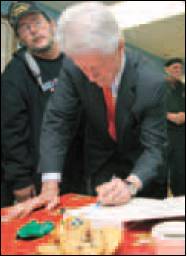
I tried explaining I was supposed to be with the "political types" and the Director told me not to worry about it, I was a disabled veteran and he wanted me to stay with the vets and meet President Clinton with them. I quickly learned why, the President spent 3-5 minutes speaking with each of us, there was a lot of laughter and plenty of pictures.
I asked him to autograph my book about the Edgewood experiments written by DR James Ketchum, Chemical Warfare: Secrets Almost Forgotten that I had purchased from Dr. Ketchum and he had signed it.
I just thought it was appropriate for the President that had finally acknowledged the immoral experiments and had publicly apologized for them should also autograph it. The apology can be viewed here" title="http://www.youtube.com/watch?v=cTiONdJJRcw">here">http://www.youtube.com/watch?v=cTiONdJJRcw">here it is about 30 seconds
“She’s the best I ever saw at making people know she can make them better off than they were previously,” the former president said. In Columbia, he met with homeless veterans at the Alston Wilkes Society where he listened to the stories of several Vietnam veterans and toured the facility. Hillary Clinton, by most polls, is in a tight race for her party’s nomination in South Carolina, Iowa and New Hampshire, the critical early voting states. Bill Clinton is being dispatched in those states to help Hillary Clinton maintain shrinking leads that once looked insurmountable. Bill Clinton, introduced at one stop as the most popular and powerful Democrat in America, wooed voters here.“Nobody knows what’s going to happen in any election,” Bill Clinton told about 100 people at Orangeburg Technical College. “But I tell you this, if she does (win), you're going to be glad you were a part of it.
Most of my regular readers know my wife is Republican (hey no marriage is perfect) but after meeting with Bill Clinton and watching him interact with me, and his offer to help with the Veterans Administration, followed up by his aide giving me his business card with an e mail address to contact them with the evidence and how they can help. She was very impressed, with him, which is to say a lot. She evens admitted as how she might even have to vote for Hillary, she feels if Hillary is even half the person Bill is then the nation will be far better off than in the hands of another republican.
President Clinton's aide gave us a business card with an e mail address for contacting the former President about the situation I find myself in. It has now been more than 12 years since the President made the public apology for the Cold War experiments that happened long before he took office, but could have only happened with his predecessors approval, the highest levels of the government had to approve the funding for many of these expensive programs, and all of them were classified at the highest levels, many unknown outside the National Security Council level, other than by the people working the projects.
To me it is amazing the people that were in government while these experiments were being conducted, some of them on the NSC, Donald Rumsfeld, Richard Cheney and at the least did not object to human experimentation, if they did not fully support it. They now find themselves in a position to help correct some of the mistakes of the past and help the people or the military veterans involved in these "classified programs" such as the Nuclear tests, the biological tests at Fort Detrick, the chemical weapons and drug experiments conducted at Edgewood Arsenal, the Operation 112/SHAD experiments of the 60s and early 70s.
They can have the Secretary of the Veterans Administration designate these men into a Category 6 level of eligibility for medical care, regardless of their present income levels, for treatment of all their medical problems. Many of the experiments these veterans were exposed to decades ago, have no tests available to see if there any direct links to the exposures then to medical issues now. The government should give these men the benefit of the doubt and since they were used in these immoral experiments, the government should keep the "Promise" and take care of them medically now. The VA Secretary has the power to make this happen.
I indicated this in my communication to President Clinton:
Mr. President, the other veterans I am in contact with are like me, no one expects the government to tell all the details of the experiments, yes a lot of the data is still classified we understand that, we do not understand why they refuse to address the environmental issues, what happened to the benefit of the doubt? At the very least all the veterans used in the experiments, SHAD, Edgewood, Nuclear and Fort Detricks Operation Whitecoat should be given a level 6 ID Card for the VA so they can obtain medical care from the VA, regardless of their income levels.
Their are many widows of the volunteers that have never been told their husbands were used in the experiments due to National Security acts we could not tell our parents, our spouses, doctor's, anyone about the experiments, We all signed the agreements and we were promised 25 years in Leavenworth if we violated them. In the September 2006 notification letters from the VA/DOD informing us that we had been identified as test subjects we were reminded by the Pentagon that we could still not discuss the experiments and the national security agreements we signed. Congress has investigated this CBS news did a 60 minutes piece on it in Jan 1991 while I was gone to Desert Storm. The experiments are not secret anymore and the Pentagon is idiotic in trying to "put that genie back into the bottle now".
The last health study did because you forced DOD to do it based on the Sarin exposures at Kamisayah Iraq in March 1991 used the Edgewood veterans as the study group after all we were the only men the nation had that had been exposed to Sarin by the Edgewood doctors, they found that 40% of the men were dead on FY 2000, 2098 men could not be found using IRS VA and SS databases, men aged 45-65 are paying taxes, drawing benefits either from the VA or SS, they don;t just disappear.
The report also showed that 54% of the 4022 survivors are disabled yet, the report never explained what the cause of the disabilities were. The report also ignored a 1994 National Institute of Health report on sarin exposures showing known medical problems Toxicity of the Organophosphate Chemical Warfare Agents GA, GB, and VX: Implic I feel it is because it would open the VA to claims from more than 100,000 veterans to heart problems, lung problems etc very expensive for 100,000 veterans to be service connected at 100%, I feel the IOM and DOD are doing all they can to ignore evidence that shows the Gulf War veterans might be sick from exposures to Sarin after all. There was also mustard agents at Kamisayah as well.
Mr President, I thank you for spending that few minutes with me in Columbia and giving me your card to contact you. We both know the VA Secretary has the ability to fix these things on his authority, the VA Secretary has enormous power granted by the President. I wish I had never raised my hand in 1974, I regret that the US did these experiments to it's own citizens and it's soldiers. My step father was in the Air Force and flew on a plane crew doing data gathering over the Nevada test site, he ended up having three kinds of cancer that is on the list of the RECA act, he died before the RECA was enacted. He never filed for Service connection from the VA because back then they would have taken away his retirement check and he did not want the problems.
Mr. President my family has served in the Army going back to my great great great great grand father who served at Valley Forge in 1776 from Barre, Mass. My Grandfather served in the Cal 4th Volunteers in the Civil War and my father served in D Troop 7th Calvary in 1914-1916 at Douglas Arizona. If the VA quits helping veterans who will volunteer in the future, I have a 16 year old son, and I am not sure I want him to serve in the Army, he should.
He would be the first Bailey male that didn't in over 225 years, but look at this mess I am in, and look how the VA is treating the Iraq war veterans, it's shameful.
I am on the Steering Committee for Military and veterans for Hillary because I believe in your wife, and General Wes Clark, I was hoping he would run honestly. I have known General Clark since NTC in the 80s when he was a Colonel and I was in the 6/31st. He was at NTC when the 48th Brigade went there in 1991 and he was a one star. Many of us Clark supporters are hoping he is the VP choice. If not I am sure he will be an asset in the future Clinton Administration.
Mr. President I hope you can help my family, and possibly the other "test vets" they at least deserve medical care from this nation at the very least.
It has been more than 32 years since the human experimentation was stopped in 1975, isn't it about time the federal government, especially the Department of Defense and the Veterans Administration stopped denying responsibility for the veterans and their families that were harmed by these experiments, the benefit of the doubt was designed for just these type of situations. There are no tests now that confirm exposure to hazardous substances months or years later, let alone decades. These men should have never been used in these hazardous experiments, and now in their later years the government does have an obligation to them and their families.
VA, House Subcommittees Spar Over Outpatient Waiting Times
VA disputes IG's findings on appointments
VA, House Subcommittees Spar Over Outpatient Waiting Times
By Stephen Spotswood
Posted: 27-December-2007
WASHINGTON—Three months after a Department of Veterans Affairs (VA) Inspector General’s (IG) audit showed that the agency is overstating success on decreasing waiting times for outpatients seeking an appointment, VA is still not agreeing with the findings, contending the IG’s methodologies were flawed. However, at a hearing on Capitol Hill in December, legislators seemed convinced of the report’s validity, and VA officials did admit that its patient scheduling process was still evolving and that the process needed evaluating.
VA policy requires that all veterans requiring care for service-connected disabilities be scheduled for outpatient care within 30 days of desired appointment dates—the date requested by the patient or the physician. All other veterans are required to be scheduled within 120 days of the requested date.
VA had reported that 96 per cent of all veterans seeking primary care and 95 per cent of veterans seeking specialty care were seen within 30 days of their desired dates. The IG audit released in September shows those percentages to be much lower. The audit found that only 75 per cent of veterans seeking care had been seen within 30 days of the desired date.
Some of the discrepancies were due to VA schedulers, who waited inordinate amounts of time before scheduling an appointment—in one case as long as seven months for a follow-up appointment—and what IG described as the disregard for the desired appointment date listed in the physician’s notes. Also, there was disagreement between the IG and VA about how to define "new" patients. The IG auditors argued that a patient already in the VA system who visits a specialty clinic should not be considered a new patient just because he or she had not visited that particular clinic before.
VA officials disagreed and called the report a worst-case scenario that did not take into account such things as patients’ preference for later appointment dates and delays on the patients’ part in scheduling follow-up appointments.
A similar IG report released in 2005 found many of the same problems, including some accounts of schedulers reporting having been instructed to falsify their entries into the electronic waiting list to make wait times seem shorter. VA officials did not disagree with the findings of the 2005 report. IG made several recommendations to VA to shore up its scheduling procedures, such as ensuring that facility managers require schedulers to create appointments following established procedures, monitoring the scheduler’s use of correct procedures, and requiring annual scheduler training on the electronic waiting list. According to IG, while some of those recommendations from 2005 have been taken, some have not, allowing the same problems to continue through today.
At a joint hearing of the House VA Subcommittee on Health and the Subcommittee on Oversight and Investigations, legislators expressed frustration at the continued problems with getting patients who need care before a VA caregiver.
"The VA has discounted the IG’s report because it disagrees with how wait times were calculated. This is unacceptable," declared Rep. Harry Mitchell (D., Ariz.), chairman of the health subcommittee. "I’m not willing to walk away from this audit over a disagreement about methodology. This is a real problem that we must look into. When our veterans encounter long waiting times, their conditions go undiagnosed and serious disease goes untreated."
"Furthermore," he said, "until we have a clearer picture about waiting times, the VA can’t improve the situation because we can’t identify problem facilities or effectively allocate resources."
Belinda Finn, IG’s Assistant Inspector General for Auditing, said that she did not understand why VA was resisting the IG’s newest findings.
"VA disagreed with our findings and said that patient preferences caused the discrepancies," Finn explained. "We find it contradictory that VA agreed with our 2005 report, but disagreed with our 2007 audit. We used the same methodology and saw a continuation of the same problems."
She added, "In 2006 and 2007, VA reported high performance on affecting appointments within 30 days. [They continued reporting this] even after we reported that the scheduling system includes inaccurate or incomplete data."
Asked what VA could do to improve its procedures, Finn said, "We made recommendations in both of our reports that VA should provide oversight of the schedulers, monitor what the schedulers do, and provide quality assurance of the data in the scheduling system. They agreed with the recommendations in 2005, but we found that they had not [fixed the problem and IG made the same recommendations in its 2007 report]."
Some legislators were worried about the reporting in 2005 in which schedulers were being directed to enter inaccurate information.
According to Larry Reinkemeyer, director of the Kansas City Audit Operations Division of the VA IG, that question was not asked in the 2007 audit; however, 7 per cent of those schedulers surveyed in the 2005 report said that they had been directed to intentionally circumvent procedure.
"So, in 2005, we did have some evidence that schedulers were directed to schedule in a particular way to affect waiting times [data]," Reinkemeyer said.
Rep. Zachary Space (D., Ohio) wondered if it is possible that bonuses for VA medical center directors were at least in part calculated on wait times that were not accurate. Controversy arose last year when legislators questioned why some VA officials were receiving bonuses as high as $30,000 when there were so many problems in the VA system, including long appointment waiting times.
"We know that waiting times are part of the performance standards for directors," Finn said. "It’s one of many factors. But we don’t have much information today on how that’s factored into a particular bonus."
Asked if there is evidence in the 2005 report that waiting times were intentionally fabricated to lower national waiting time rates, Finn said, "We know that some of the practices that schedulers have told us about would serve to understate wait times. Whether that was a widespread practice or not, [we don’t know]."
Reinkemeyer said that at least two of the common procedures by schedulers recorded in 2005 that lower documented wait times—whether intentionally or not—still exist today.
The first procedure, he said, "Is taking longer than allowed before putting [a patient] on the electronic waiting list." If a patient is not scheduled for an appointment within seven days, that patient goes on the electronic wait list.
"By holding on to those referrals for more than seven days and not put them on the wait list, that serves to understate the wait list," Reinkemeyer said.
"The second procedure is a common practice for a scheduler to find out what the first available appointment [is] and use that as the desired date of care, which effectively reduces the wait to 0," he explained.
Testifying before the joint subcommittees, Dr. Gerald Cross, VA’s Deputy Under Secretary for Health, continued to refute the calculations in the IG report.
"VA has several concerns about the OIG’s audit methodology that was used in the 2007 report," Dr. Cross said. "There was a difference in our analysis [of wait times] and our review of the IG report of 2007, and there were significant differences that we found."
Dr. Cross did not elaborate on why the same IG methodology did not concern VA when it reviewed the 2005 IG report.
Dr. Cross also argued that VA is still in the process of implementing recommendations made by IG in 2005, including comprehensive training of anyone using VA’s scheduling system, including physicians who like to schedule their own patient appointments. To date, VA has trained 40,000 people to use the scheduling system, and plans to revise the training annually and retrain its employees annually.
"VA is proactively taking steps to review the total scheduling process," Dr. Cross said. "To this end, VA has contracted with an independent third party to conduct an evaluation of VA’s scheduling practices and waiting time metrics. The contractor is beginning the pilot program phase of its assessment, and VA anticipates receiving the final report in spring of 2008." VA is also in the process of developing a new scheduling software package, as well as developing short-term software solutions for its current scheduling package, which Dr. Cross called "antiquated software."
However, that new software package will not be up and running until 2011.
Impact Of Delay On The Front Lines Of Care
To help understand the front-line picture of what dealing with VA scheduling procedures is like, the legislators heard from Mary Jones, a county veterans service officer in Licking County, Ohio. Jones has helped veterans find their way through VA bureaucracy for 12 years, and testified that, no matter whether you believe the VA’s data or the IG’s audit, the waiting times are long and frustrating.
"My concern with outpatient waiting times is our inability to get veterans into an appointment in a timely manner," Jones said. "Their appointments are scheduled so far out—often two to three months—that their condition worsens and they are left angry and frustrated at a system that is supposed to be in place to care [for them]."
One example she gave is of a veteran recently discharged, who was promised dental care within 90 days of discharge. VA scheduled his appointment for almost the full 90 days later, but when he arrived at the dental clinic he was told that appointment needed to be cancelled.
"They did not have any appointments available within the 90-day period he was entitled to dental care, and therefore he was not seen."
Another rising concern is getting care for veterans with post-traumatic stress disorder (PTSD) when their benefits claim is still being processed.
"Usually, when we file a claim, we have a veteran who has a diagnosis for a condition, but PTSD is different," Jones contended. "Most veterans can get into the VA to see a social worker and can get assigned to group counseling fairly quickly. Most can see a psychiatrist within three to four months for an initial exam, but within the 12 to 18 months that a service-connected claim takes to adjudicate, the veteran is still left without a diagnosis for PTSD because the wait times prohibit the doctor from seeing the patient often enough to provide a definitive diagnosis of any mental health."
Because no diagnosis exists, the Veterans Benefits Administration must deny the claim for service connection, Jones said, adding that seeing private psychologists is a financial burden for most veterans.
Rep. Ginny Brown-Waite (R., Fla.), whose proposed bill, H.R. 92, the "Veterans Timely Access To Health Care Act," would require VA to reimburse veterans for care at non-VA facilities if VA is unable to furnish the patient with an appointment within 90 days, asked Jones whether such a measure would be a good or bad idea from her point of view.
"I have to say that it’s encouraging to think we’re looking outside of the box," Jones said. "For me, the possibility to use outside physicians might be a good idea. These are outside physicians who would treat veterans eventually, anyway, [and they] might get some training on treating [veterans] right now. Most don’t even ask [their patients], ‘Are you a veteran?’"
Rep. Brown-Waite stressed that she was not seeking to privatize any part of VA care with her legislation, but argued, "Care not rendered in an expeditious manner is not quality care."
The bill is still awaiting action in the House VA Committee.
--------------------------------------------------------------------------------
More daily news:
House Committee Slams VA On Veteran Suicides
Congress Passes Bill To Increase Defense Health Program Budget
VA, House Subcommittees Spar Over Outpatient Waiting Times
More Recent News Highlights
An Editorial from San Antonio and my thoughts at the bottom
San Antonio Editorial on new VA Secretary
Editorial: New VA secretary has huge challenge
Web Posted: 12/27/2007 05:56 PM CST
San Antonio Express-News
As 2008 approaches, veterans hope the new year is brighter than the one about to end.
Cynics will say it could not be much worse.
But the hope seems well placed, considering the credentials of the new secretary for the Department of Veterans Affairs.
Army Lt. Gen. James Peake, confirmed earlier this month, succeeded a man who resigned over criticism of poor medical care at VA facilities throughout the country, James Nicholson.
As the first doctor and military general named to lead the VA — he served as surgeon general for the Army from 2000 to 2004 — Peake is uniquely qualified to address the problems at the scandal-plagued department.
The VA's troubles will provide an opportunity for individuals of conscience and integrity to rectify the problems, which include the following:
Staffing shortages at facilities, especially those in rural areas.
Delays in responding to health care claims.
Funding.
Peake promised to look into these issues.
"I understand I'm part of the administration," Peake told the Senate Veterans Affairs Committee during his confirmation hearing, according to news reports. "But I also have a responsibility to the administration and this committee to lay out the situation openly and honestly and to fight for the resources to do my job, which is to take care of veterans."
It is a noble agenda, but he has taken on a huge challenge.
Peake will need a partner in undertaking that challenge, and the partner is the Congress, which cannot forget the problem by pawning it off on the secretary.
At least one senator agrees with that assessment, Arlen Specter, a Republican from Pennsylvania, who told the Los Angeles Times that if the secretary asks for more resources, the "entire Congress" will support him.
As 2008 — and the years beyond — unfold, veterans will remember the pledges of both men.
*************************************************************************************
The thing veterans will be watching is will Secretary Peake be working to help them and their families or to keep a lid on the cost of care and compensation as the past VA Secretaries have done, it's admirable that the Bush Administration takes the claim they have raised VA spending 70% the trouble with their argument is on the compensation side of the budget, it is mandatory if a veteran files a claim and it is determined that the problem is service connected then the money
HAS to be paid which is approximately 50% of the VA budget. It didn't matter who was President or who will be President that money has to be allocated. It has been shown that on the health care side of the budget that it has always been short changed, in 2005 Senator Patty Murray D-Wash attempted to get a 2 billion dollar supplemental thru the Congress for the VA for mental health and other financial shortages, the Republicans voted her measure down, yet less than three months later Secretary Nicholson came to Capitol Hill and asked for one billion dollars at the beginning of June 2005, by the end of the month he was back asking for a second billion, it turns out Senator Murray was correct in her assessment of the shortages.
Instead of being treated like beggars asking for a hand out, this nations veterans deserve all the health care they need, not rationed appointments, if the VA can NOT deliver it, then they should be outsourcing it to local hospitals and paying the bills, these veterans have earned it, by their service.
The claims process for compensation should not be the adversarial process it is now and has been since the end of the Korean War, the veterans are denied the "benefit of the doubt" they have to
prove" they were harmed in service and many times there is no documentation to prove it happened on this battlefield at this time. Many of the witnesses are either dead or you know their names but have no idea where they moved to after the military and have to deal with the VA 3-30 years later.
The claims and appeals process should not be a 2-10 year process, the files are all paper, some of the claims folders are 2-10 feet thick and no one is reading all of the evidence, many times the documents the veterans need to "prove" their case is at the bottom of the file and has been there the entire time, just overlooked, and the VA does not say sorry, does not pay interest on the withheld funds for 5 years.
In the meantime most of the veterans have had their marriages destroyed by lack of money, they have lost their homes, their cars, their children and their dignity, there has to be a better process. The veterans have earned it, most are asking for justice, not a get rich quick scheme, most veterans I know want just what they are owed, nothing more and nothing less, prosecute the frauds and few will be determined to file fraudulent claims, the idea of a few years in prison will deter all but the truly criminal. Most of the men and women I met in the service are anything but criminal. They deserve better than what they have been getting from the VA and Congress.
Legionnaire's disease at the Brecksville veterans hospital.
Is Legionnaires Disease Back again?
Possible Legionnaire's Outbreak Investigated At VA Hospital
POSTED: 5:25 pm EST December 27, 2007
UPDATED: 5:53 pm EST December 27, 2007
BRECKSVILLE, Ohio -- Cuyahoga County health officials are investigating a possible outbreak of Legionnaire's disease at the Brecksville veterans hospital.
At least three cases have been reported at the Louis Stokes Department of Veterans Affairs Medical Center since November.
The pneumonia-like disease is caused by a bacteria found in warm-water environments.
Health officials have been working with the VA to assure they are following proper procedures with their water system.
Legionella, the bacteria that causes the disease, is not as rare as you might think, NewsChannel5's John Kosich reported.
"Studies have shown that up to 50 percent of large building facilities, including hospitals, has this bacteria in the water system," said Cuyahoga County Board of Health's Chris Kippes.
The key to getting rid of it is making sure water is heated to at least 140 degrees.
On average, there are 50 cases of Legionnaires reported in Cuyahoga County each year.
The tree people from the VA have all been treated and released.
Copyright 2007 by NewsNet5. All rights reserved. This material may not be published, broadcast, rewritten or redistributed.